Lifestyle Symbols 101: Pineapples, Black Rings, and Other Signals to Spot
You’re at a pool party. Someone walks past with an upside down pineapple printed on their hat. Across the deck, a couple at the next table both wear black rings on their right hands. You catch yourself wondering: am I imagining a pattern, or are these people signaling something?
You’re not imagining it. Welcome to the world of lifestyle symbols.
Swingers, hotwives, polyamorous couples, and ENM (ethical non-monogamy) communities have developed a small vocabulary of subtle visual codes over the past few decades. These symbols solve a specific problem: how do you find other people like you without exposing yourself to the people who wouldn’t get it (or might judge you for it)? The answer is plausible deniability. Wear a symbol that other lifestylers recognize and everyone else reads as a quirky accessory.
This is a comprehensive guide to the most common lifestyle symbols, where they came from, how to spot them, how the community uses them online and in person, and how to start using them yourself if you’re curious about signaling.
Why symbols exist in the first place
The lifestyle is more common than people think, but it stays mostly invisible because of social stigma. Researchers studying consensual non-monogamy have found that a significant minority of American adults have engaged in some form of CNM at some point in their lives, with even more reporting interest or curiosity. That’s a lot of people. Yet most lifestylers can’t drop “we’re swingers” into a casual conversation at work without major social consequences.
Lifestyle symbols thread the needle. They let you say “I’m part of this community” to the right audience while saying nothing at all to everyone else. The same hat says “find me” to a swinger and “cute pineapple” to your aunt.
This is why the symbols have endured even after TikTok publicly “decoded” some of them. Plausible deniability still works because most non-lifestyle people don’t pay attention to lifestyle TikTok, and even when they have seen the videos, they forget. The symbols continue to function.
A brief history of lifestyle signaling
The modern lifestyle community traces its visible roots to the 1950s and 1960s, when “key parties” and “wife swapping” started appearing in suburban America. Those early gatherings were almost entirely word-of-mouth. You knew about them because someone you trusted invited you. No symbols, no codes, no public face. Discretion was absolute, and so was the gatekeeping.
The first widespread lifestyle symbols appeared in the 1970s and 1980s, as swinger clubs began to open in major cities and lifestyle vacations became more common. Couples needed ways to identify each other at non-lifestyle venues (hotel bars during conventions, restaurants near lifestyle clubs, vacation destinations). The earliest signals were practical and informal: specific colors worn together, jewelry placed in non-standard positions, drinks ordered in specific combinations.
The Caribbean cruise industry seems to have crystallized the modern symbol set during the 1980s and 1990s. Adults-only resorts and clothing-optional cruise lines built lifestyle-friendly environments where signaling could happen openly. Pineapple iconography, originally a Caribbean hospitality symbol borrowed from colonial-era welcome decor, started showing up in lifestyle-coded form. The “upside down” version, specifically, took hold because it preserved plausible deniability for the wearer while remaining recognizable to those in the know.
The black-ring-on-the-right-hand signal emerged from a different lineage. It traces to online lifestyle forums in the late 1990s and early 2000s, where members proposed a discreet identifier that would work in everyday life. Black rings were already in fashion, the right-hand placement was distinct from wedding-band conventions, and the design didn’t draw attention. Within a few years, you could spot black rings at lifestyle conferences, swinger cruises, and clubs across North America.
Then came social media. The 2010s brought a surge in lifestyle visibility through Tumblr (before the 2018 adult-content ban), Twitter, Reddit, and eventually TikTok. Pre-existing symbols got documented, photographed, and shared. By 2018, TikTok creators were posting “decode the upside down pineapple” videos that racked up millions of views. The community panicked briefly, then shrugged. The symbols continued working because most non-lifestyle people forget the videos within a week.
Today’s lifestyle signaling is more public than it has ever been but somehow still works. The reason is volume of noise: even when a symbol becomes “famous,” most strangers in the wild don’t recognize it in the moment. Plausible deniability survives.
The major symbols
Upside down pineapple
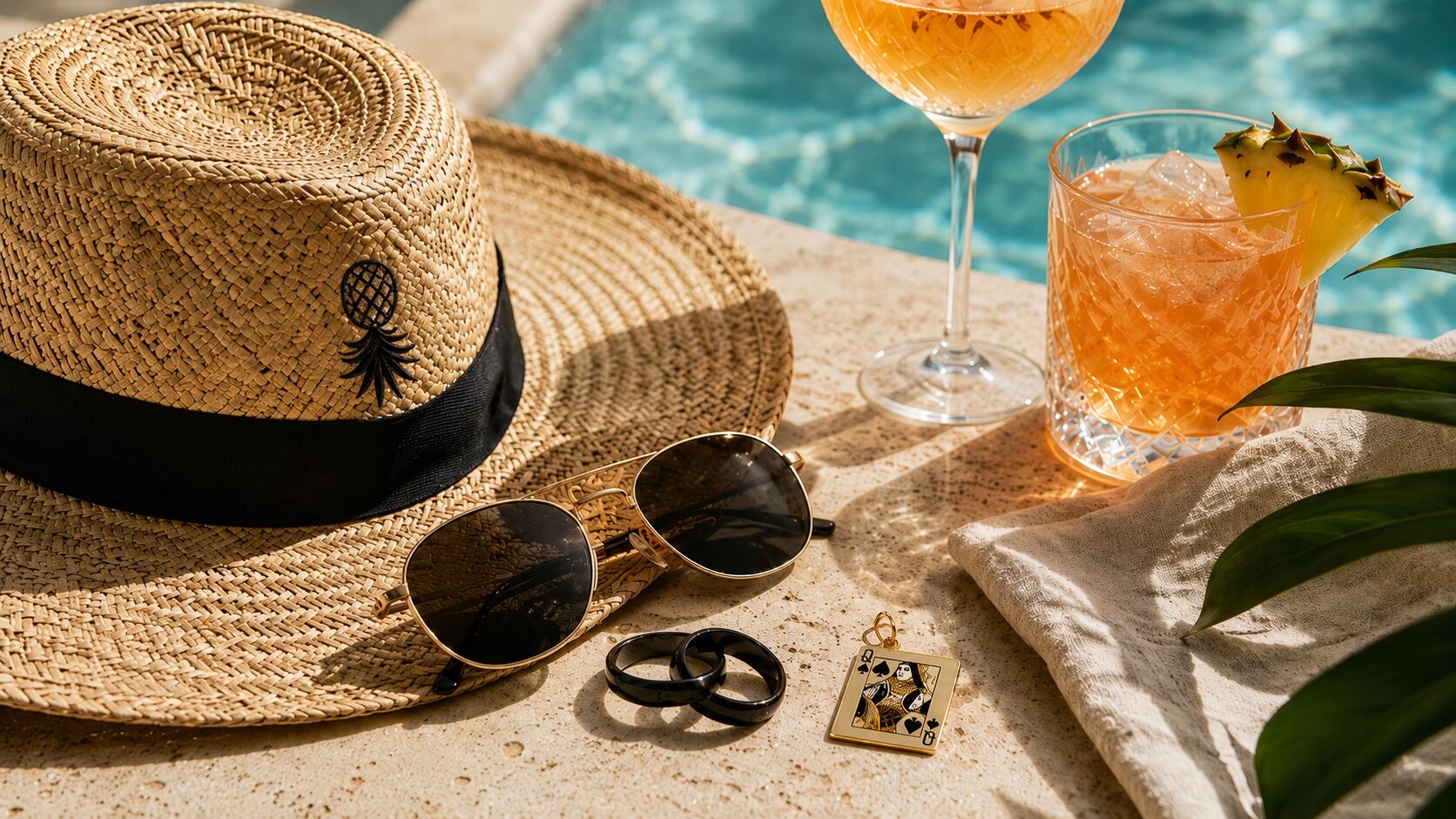
The most recognizable signal in the lifestyle. A pineapple turned upside down (on a hat, shirt, decal, can cooler, or piece of decor) is the swinger-community shorthand for “we play with other couples.” The right-side-up version is just a tropical hospitality symbol; the flip is what shifts the meaning.
The pineapple appears on:
- Hats and apparel at resorts and cruises
- Car decals and stickers
- Home decor like welcome mats and ornaments
- Cocktail stir sticks and party supplies
- Dating-app profile photos and bio emojis (often paired with rotation indicators)
If you want the full deep dive on where this symbol came from, how to wear it without being awkward, and the complete collection of pineapple gear, check out our companion guide on Wicked Boutique: What Does an Upside Down Pineapple Mean? The Swinger Symbol, Decoded.
Black ring on the right hand
A solid black ring worn on the middle finger of the right hand is one of the most established lifestyle signals. It is older than the pineapple, more discreet, and easier to wear in everyday life without drawing attention. The ring goes on the right hand specifically because left-hand ring fingers signal “married” or “engaged” in mainstream Western culture. The right hand keeps it separate.
Black rings come in many materials (silicone, tungsten, ceramic, basic metal) and don’t have to be ostentatious. The signal is the placement, not the design. Black silicone bands have become especially common because they look like a basic fitness or active-lifestyle accessory to outsiders while still reading correctly to people in the know.
A few notes on reading this signal: not every black ring on a right hand is intentional. Some people just like black rings. Some Goth or alternative-style folks wear them aesthetically. As with all lifestyle symbols, context matters. A black ring at a lifestyle resort: probably a signal. A black ring on a teenager at a music festival: probably just a ring.
Queen of Spades, Bull, and hotwife symbols
Inside the lifestyle, there are sub-communities with their own signals. The Queen of Spades (often abbreviated QOS) refers to white women who exclusively or primarily play with Black men. A QOS symbol (the playing-card Q with a spade) on jewelry, a tattoo, or apparel signals this preference openly. The corresponding “King of Spades” is sometimes used by Black men in the same dynamic.
The Bull symbol (often a bull silhouette or horns) signals the active masculine role in hotwife dynamics, where one partner watches or shares their wife with another man. Couples involved in this dynamic sometimes wear matching bull-and-vixen jewelry. The vixen counterpart (a fox or stylized female silhouette) typically goes on the wife’s side of the pair.
Anklets have a long association with hotwife signaling. A single anklet on the right ankle, worn alongside more conventional jewelry, is occasionally used as a hotwife indicator at lifestyle events. The convention is regional and inconsistent enough that most anklets are still just anklets.
Color-coded jewelry
Some lifestyle couples use a specific three-color combination (often black, white, and red) to indicate openness. This is less universal than the pineapple or the black ring but appears at lifestyle resorts and cruises. The colors might show up in beaded bracelets, anklets, layered necklaces, or even color-coordinated outfits worn together.
Toe rings
A second-toe ring (the toe next to the big toe) on either foot is sometimes used as a discreet swinger signal. This one has less consensus across communities than the others, and most toe rings genuinely are just fashion accessories. Use context to read it.
Garden gnomes facing outward
This one is more meme than reality, but in some neighborhood lore, a garden gnome facing outward toward the street is rumored to be a lifestyle marker. Take it with a heavy grain of salt. Most garden gnomes are just garden gnomes.
IYKYK aesthetic
Beyond specific symbols, lifestyle spaces use an entire visual vocabulary built on “if you know, you know” energy. Specific font choices, pineapple-pattern fabrics, palm tree iconography paired with the upside down pineapple, vintage-cocktail-bar aesthetics. The look itself becomes recognition. You don’t need a specific symbol if your whole vibe reads as lifestyle-coded.
How to spot symbols in real life
A few rules for reading signals correctly:
Look at context, not just the symbol. A pineapple decal on a minivan with three car seats? Probably not a signal. The same decal on a couple’s matching travel mugs at a poolside resort bar? Probably is.
Watch for clusters. One symbol could be coincidence. Two or more on the same person (the pineapple hat AND the black ring) basically confirms it.
Body language confirms the read. If you make eye contact with someone wearing a possible signal and they hold the look a beat longer than a stranger normally would, they probably saw you noticing.
Settings change meanings. A pineapple at the elementary school book fair is fruit. A pineapple at a clothing-optional resort is a signal. Adjust your read based on where you are.
Venue-specific conventions
Different lifestyle environments have different signaling norms. Here’s a quick map:
Lifestyle resorts (Hedonism, Desire, Temptation, Caliente). Signaling is more openly worn here because everyone is already in the lifestyle. The pineapple hat is basic equipment, not a code. Couples often wear matching themed outfits and lifestyle-specific apparel without any subtlety. Wear what you want at these venues.
Lifestyle cruises and takeover weekends. Similar to resorts but with more variety because cruises and takeovers happen at venues that aren’t lifestyle-exclusive year-round. Other passengers might be non-lifestyle, so signaling stays slightly more measured during shared public hours and gets bolder at evening events.
Hotel bars near lifestyle conferences. A specific subculture exists at hotels hosting events like Naughty in N’Awlins, Desire weekends, or local lifestyle conventions. Attendees often pre-game and wind down in the hotel bar. Signals are higher volume here than in random hotels because the audience skews lifestyle.
Vanilla spaces. Subtle only. A pineapple keychain, a black ring, a discreet pin on a jacket. The goal in vanilla spaces is to be findable to other lifestylers without being identifiable to coworkers, neighbors, or family. Match volume to risk tolerance.
Adults-only RV parks and clothing-optional venues. A lot of overlap with general nudist culture, but lifestyle-friendly variants exist (some adults-only RV parks are explicitly lifestyle-friendly, others are just non-kid spaces). Read the room before assuming everyone is in the same community.
Online lifestyle signaling
While the in-person symbols get the most attention, lifestyle signaling has gone fully digital. Lifestyle communities have developed an entire vocabulary of online codes that work the same way as the pineapple: visible to insiders, invisible to everyone else.
Username conventions. Couples on lifestyle sites (Kasidie, SLS, SDC, Fetlife) often use “Mr&Mrs[Name]” or “[Name]Couple” formats to signal partnered status. Singles often use “Single[Adjective]” or initials-only handles. The lack of a profile photo on a lifestyle site usually signals discretion, not absence; the absence of a photo on a mainstream dating app signals something different.
Profile shorthand. Lifestyle profiles often use very specific abbreviations:
- “Soft swap” vs. “Full swap” indicates what level of play the couple is open to
- “Vanilla” means non-lifestyle (often used in the negative: “we’re not vanilla”)
- “MFM” or “FMF” describes the typical group composition the couple prefers
- “Same room” vs. “Separate room” indicates whether partners want to stay in visual contact during play
- “DDF” means “drug and disease free” and is essentially required language in profile bios
- “On premise” vs. “off premise” describes club types where play happens versus where it doesn’t
- “Friends first” indicates a couple wants to build social rapport before any physical play
Dating app signals. On mainstream apps (Tinder, Hinge, Bumble), lifestyle-curious users sometimes signal openness through emoji combinations in their bio. The pineapple emoji 🍍 by itself can be coincidence, but a pineapple paired with a rotation arrow or explicit “upside down” reference is intentional. Other common emoji conventions include peppers and corn for “spicy” couples, unicorn emoji for single women available for couples (used carefully because of “unicorn hunting” ethics concerns), and combinations of hotel emojis with travel emojis for couples open to lifestyle vacations.
Twitter and X. The most permissive mainstream platform for adult-lifestyle content. Lifestyle accounts use specific hashtags like #hotwife, #stagandvixen, #lifestylecommunity, and #ENM. Username conventions often combine first names with “_LS” or “_Couple” suffixes.
Reddit. Subreddit choice itself is the signal. Active accounts on r/Swingers, r/Hotwife, r/swingerlifestyle, r/openrelationships, r/polyamory broadcast lifestyle identity through participation, not through codes. Many users keep separate “lifestyle” Reddit accounts entirely, distinct from their vanilla accounts, to compartmentalize.
Content creator overlap. A significant portion of the lifestyle community produces or consumes content on adult platforms. The presence of a couple’s joint fan account linked in their lifestyle profile is itself a signal: this couple plays publicly. The absence of public content combined with otherwise active lifestyle social media often signals “we play privately.”
Couples vs. solo signaling
The lifestyle is overwhelmingly couple-oriented, but single men and single women participate too. The way each group signals differs.
Couples. Joint signaling is the default. Matching jewelry, coordinated outfits at events, his-and-hers themed apparel. The pineapple hat works as a couple signal because both partners wearing one (or one on each car, or a shared decal on a vehicle) doubles the visibility and confirms intent. Couples often have a primary signaler and a secondary signaler within the pair, where one partner wears the more obvious symbol and the other wears something complementary.
Single women. Often signal more discreetly through profile choices and venue selection rather than overt symbols in public. A single woman wearing a “vixen” tee at a swinger event is loud and welcome; the same shirt at a coffee shop reads differently. Single women in the lifestyle (sometimes called “unicorns,” though that term carries baggage in the polyamory community) often rely more on online platforms than in-person symbols. The unicorn convention also exists as a warning sign: couples who use “unicorn hunting” language without acknowledging the ethics concerns are often poorly-regarded in the community.
Single men. Face the steepest signaling challenge. Most lifestyle venues are strict about gender ratios, and the community is wary of “single male” energy because the worst behavior in the scene tends to come from that demographic. Single men who participate in the lifestyle ethically often emphasize their references, vouches, and history rather than visible symbols. Wearing a pineapple as a single man in a vanilla space is more likely to be read as creepy than recognized as signaling.
Stag/vixen couples. A specific subset where the man enjoys his partner playing with others (the “vixen”) with or without him (the “stag”). Stag/vixen couples often signal more loudly than regular swinger couples because the dynamic depends on visibility. Bull symbols, vixen-themed jewelry, and explicit “hotwife” apparel are common.
How to start using symbols yourself
If you’re new to the lifestyle and want to start signaling, the move isn’t to wear “SWINGER” across your chest at Target. Subtlety is the whole game.
Start small. A keychain on your bag, a small decal on your laptop or car, a discreet black ring you can wear out without commentary. Notice if you start spotting other people who seem to notice you back. The community is bigger than you think.
Escalate the volume to match the venue. At a lifestyle event, go bigger (graphic tees, themed gear, room decor). At a Tuesday-night grocery run, keep it subtle. Match the signal to the audience.
Common misreads and what NOT to do
If you’re new to spotting and using lifestyle symbols, a few patterns to watch out for:
Don’t assume based on one symbol alone. Context matters. A pineapple shirt at the elementary school book fair is probably just a shirt. Don’t approach strangers based on a single ambiguous signal.
Don’t approach without verifying interest. Spotting a symbol doesn’t mean the person wants to be approached. Make eye contact, smile, see if they engage. If they look away or don’t return the energy, drop it. Lifestyle signaling is about finding mutual interest, not announcing availability for unsolicited propositions.
Don’t out people. If you spot someone signaling at a vanilla venue and you happen to know them socially, never comment on it in public. The whole point of plausible deniability is that the wearer gets to choose when and where to acknowledge their lifestyle identity. Calling them out in front of mutual friends violates that.
Don’t wear symbols you don’t understand. A growing number of lifestyle-adjacent items have been turned into fashion pieces by people who have no idea what they’re advertising. The cute upside down pineapple tee from a fast-fashion retailer was probably designed by someone who didn’t know. If you’re wearing a symbol because you genuinely want to signal, fine. If you’re wearing it because it’s cute, be ready for the conversation it can start.
Don’t fake it for clout. Wearing lifestyle symbols when you’re not actually in the lifestyle (or open to it) is the equivalent of wearing a flag from a country you’ve never visited. It’s not harmful, but you’ll feel weird when someone correctly reads the signal and starts a conversation you can’t continue.
Don’t pressure your partner. If you’re curious about signaling but your partner isn’t, don’t unilaterally start wearing lifestyle symbols on shared property (your car, your house decor, joint social media accounts). Lifestyle signaling implies the partnership signals, not just one half.
Don’t bring kids into signaling spaces. If you wear lifestyle gear when you’re with your children, you’re potentially creating uncomfortable conversations for everyone around you who can read the signal. The pineapple keychain on the diaper bag is a particularly awkward example. Save the signaling for the times when you’re not parenting in public.
Important caveat: symbols are not consent
This is worth saying clearly. A lifestyle symbol signals “I’m in this community, I’m open to meeting other people in this community.” It does not signal “yes” to any specific person or proposition. Standard rules of conversation, respect, and explicit consent still apply.
If you see someone wearing a pineapple hat, that doesn’t mean you can walk up and proposition them. It means they might be open to a friendly conversation that, if it goes well, might lead somewhere. The symbol opens the door. The actual interaction still has to earn the rest.
Frequently asked questions
What’s the most common lifestyle symbol?
The upside down pineapple is the most widely recognized, but the black ring on the right hand is arguably older and more reliable. Pineapples have higher recognition outside the community thanks to viral TikTok content; black rings stay more discreet.
Are there lifestyle symbols specific to LGBTQ+ couples?
Yes, though there’s significant overlap. The LGBTQ+ community has its own established symbol vocabulary (rainbow flags, bear pride flags, leather pride flags, and many others), and queer lifestyle couples often combine those with general lifestyle codes. The carabiner clip on the belt has cultural roots in lesbian community signaling that predates modern lifestyle adoption.
Can I make up my own lifestyle symbol?
You can wear whatever you want, but a “symbol” only functions as a signal when other people recognize it. A symbol you invented yourself works as personal expression but not as community signaling. If you want recognition, use established codes.
Do lifestyle symbols still work after going viral on TikTok?
Mostly yes. The community worried briefly in 2018 when viral videos exposed the pineapple meaning, but the symbols continue to function because most non-lifestyle people don’t remember the videos, and the people who do remember rarely encounter the symbols in the wild. Plausible deniability survives at scale.
What if I see someone with a symbol but I’m not interested in approaching?
Then don’t approach. Nothing about a lifestyle symbol obligates anyone (the wearer or the observer) to engage. You can recognize a signal and just acknowledge it internally. The community wears these things to find each other, not to recruit.
Are lifestyle symbols safe to wear in conservative areas?
Risk varies by location and how loud the signal is. A discreet black ring almost anywhere in the US is fine. An “I’m a swinger” t-shirt in a small rural town might attract unwanted attention. Match the signal volume to the venue’s tolerance. The pineapple hat passes basically everywhere because most strangers don’t read the meaning.
Can I take off the symbols when I want to?
Of course. Lifestyle signaling is a choice, not a brand. Many people in the lifestyle keep symbols for vacation and weekend events and stay completely vanilla in their work and family life. The flexibility is part of the design.
What if I’m in the lifestyle but my partner isn’t comfortable signaling publicly?
Respect that. Lifestyle participation requires both partners’ consent, and so does public identification with the community. If your partner prefers not to signal in public, keep your wardrobe and decor neutral. Save the signaling for spaces where you’re both comfortable being visible.
What does it mean if I see someone wearing a black ring AND a pineapple symbol?
That’s about as confirmed as lifestyle signaling gets. Two independent symbols on one person is well beyond coincidence. They’re in the lifestyle and they’re open about it.
Are there lifestyle symbols I should avoid wearing because they signal something specific I’m not into?
Yes. Queen of Spades, Bull, and stag/vixen symbols signal specific dynamics (BBC preference, hotwife arrangements) that aren’t universal across the lifestyle. Wearing those symbols if you don’t actually practice those dynamics will lead to mismatched conversations. Stick with general lifestyle signals (pineapple, black ring, color codes) if you don’t want to commit to a specific sub-niche.
Where to go from here
If you’re new to the lifestyle and finding all of this overwhelming, start with our foundational primer: What is the Lifestyle? A Beginner’s Guide to Swinging and ENM. It defines the vocabulary, explains the basics, and points to further reading.
If you want to start collecting your own signaling gear, our partner shop Wicked Boutique carries hats, apparel, decor, and accessories with most of the symbols mentioned above.
And if you want the deep dive on the most popular symbol of all, our pineapple-specific guide goes deep: What Does an Upside Down Pineapple Mean?